

“Everyone should be quick to listen, slow to speak and slow to become angry.” — James 1:19
I recently immersed myself in a month-long training on Radical Listening, and it’s been reshaping the way I coach, communicate, and connect. My Focus is deeply embracing this shift, and I couldn’t be more thrilled to explore Radical Listening and CliftonStrengths® with you.
The truth is: most of us listen to reply.
Few of us listen to connect. Even fewer listen to transform.
Radical Listening invites us to a deeper level of presence, compassion, and courage. It’s not just a communication technique, it’s an intentional mindset. And it aligns beautifully with the CliftonStrengths® philosophy, ICF core competencies, and biblical wisdom.
Let’s explore what Radical Listening is, and how it can help you lead and coach more effectively.
What Is Radical Listening?
Authors Christian van Nieuwerburgh and Robert Biswas-Diener describe Radical Listening as the intentional, compassionate practice of helping others feel seen, valued, and heard.
Radical Listening is different from traditional “active listening,” which tends to emphasize reflection and clarification. Radical listening begins with positive intention and seeks to build connection and trust within the context of understanding. It’s deeply relational.
In a divided world, Radical Listening is a bridge, strengthening relationship and building teams. For leaders and coaches, it cultivates the space where insight, ownership, and transformation emerge.
(To learn more from the authors themselves, check out this full interview with Christian van Nieuwerburgh and Robert Biswas-Diener.)
Reflection:
– How does Radical Listening differ from the way you typically listen?
– When was the last time you felt truly heard?
Radical Listening and CliftonStrengths®: How Strengths Help (And Sometimes Hinder)
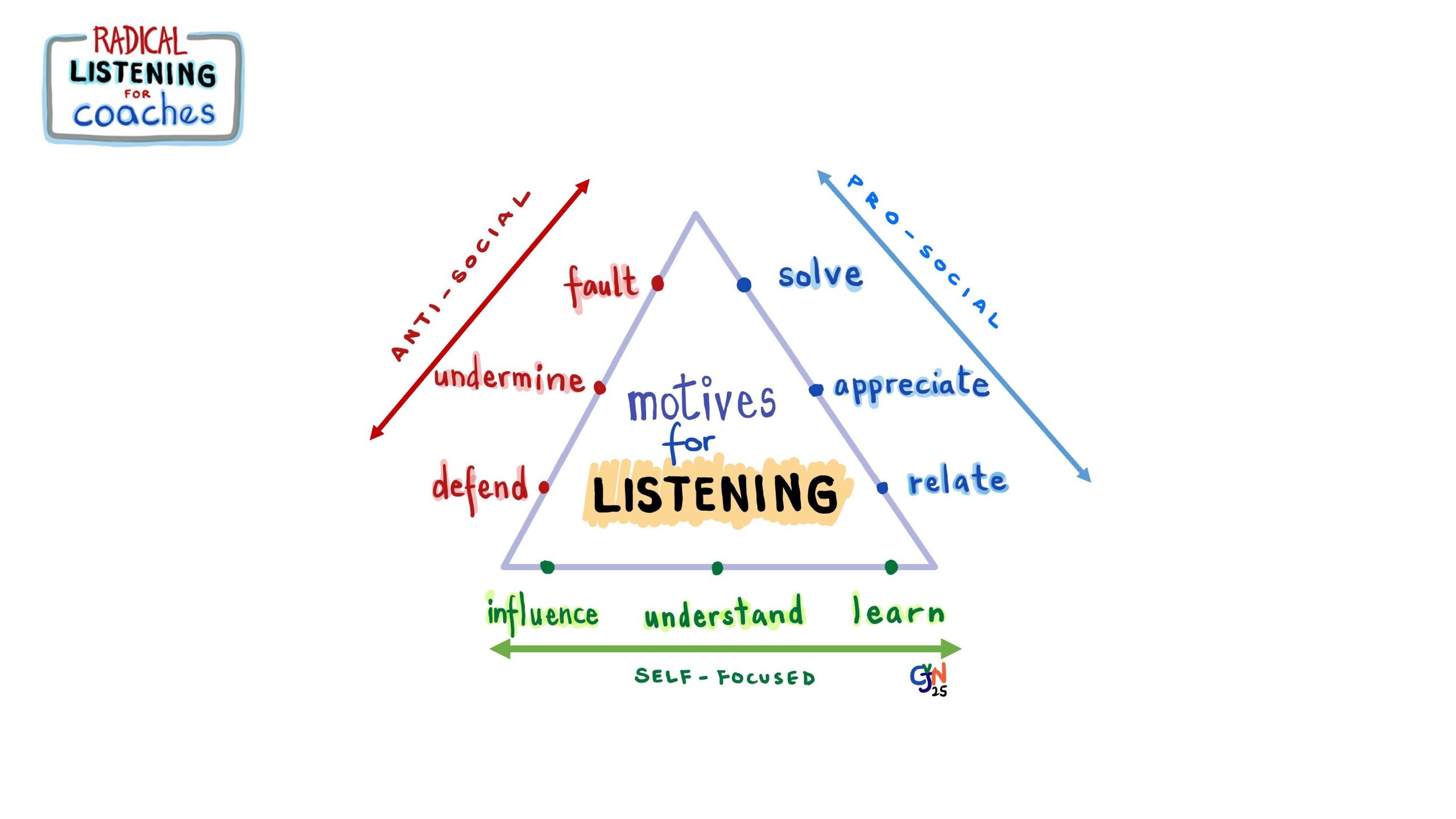
Your Strengths influence how you listen: what you notice, what you filter out, and what drives your response.
For example:
– Leaders with Empathy® may intuit emotion, but struggle to hold space when overwhelmed.
– Analytical® may listen to solve, rather than to understand.
– Relator® may think they already know someone’s story and stop listening too soon.
– Activator® may interrupt with good intentions, but disrupt the speaker’s flow.
Radical Listening invites us to intentionally regulate our Strengths with the moment’s need, not our natural reflex. That means turning down the volume of our Strengths when needed and turning up humility, curiosity, and presence.
Ready to Facilitate & Train with Confidence? Join My Upcoming Masterclass
Before we explore the six core principles of Radical Listening, I wanted to share an upcoming opportunity to advance your group facilitation skills:
Join me on July 25th from 8:30 AM – 12:00 Noon CT for the Strengths Champion Facilitator Masterclass, a dynamic, live virtual training designed for coaches, leaders, and HR professionals who want to:
– Master CliftonStrengths® principles
– Facilitate transformative strengths-based workshops
– Integrate experiential activities into groups and masterminds
– Build your business or leadership brand with confidence
This masterclass is designed to maximize and mobilize your impact. Reserve your spot here.
The Six Core Practices of Radical Listening
Here’s a brief overview of the Radical Listening model and how each skill connects to coaching and Strengths-based leadership. I’ll dive deeper into these practices in part two.
1. Noticing
Definition:
Noticing is the foundational skill in Radical Listening. It involves tuning into both the speaker and yourself. Tone, pace, body language, emotion… all the things that communicate inner states.
Biblical Lens:
“Let the wise listen and add to their learning.” — Proverbs 1:5
Wisdom begins with attention. Throughout Scripture, we see examples of godly leaders (like Solomon or Jesus) discerning not just what was said, but what was beneath the surface.
Coaching Application:
As a coach, noticing means more than observing surface-level cues. At the MCC level, you’re listening with your eyes and ears for micro-shifts in voice, posture, and emotional energy. You also notice your own reactions (curiosity, assumptions, or discomfort) and use them as data rather than distraction.
Reflection Questions:
– What typically distracts you from truly noticing during conversations?
– How would improving your noticing change the way you show up as a coach or leader?
2. Quieting
Definition:
Quieting is the practice of silencing internal chatter, judgment, and agenda so you can offer your full attention.
Biblical Lens:
“Be still and know that I am God.” — Psalm 46:10
Stillness prepares the heart to receive. Just as spiritual growth begins with quieting the noise of the world, listening well begins with quieting the noise within.
Coaching Application:
Before coaching sessions or hard conversations, take a moment to pause, breathe, and notice your inner state. Strengths like Achiever®, Strategic®, or Ideation® may tempt you to stay in motion or planning mode. Quieting brings you back to presence.
Reflection Questions:
– What helps you mentally and emotionally quiet yourself before conversations?
– When you’re under pressure, how does that impact your ability to listen?
3. Accepting
Definition: Listening without needing to correct, control, or fix. Accepting honors the speaker’s lived experience and perspective.
Biblical Lens: Jesus’ encounter with the woman at the well (John 4) is a powerful example of listening with full acceptance and no condemnation.
(You can learn more about the ways Jesus embodied the core competencies of ICF coaching here).
Coaching Application: Strengths like Belief®, Consistency®, or Command® may carry strong values. Lean on them to hold space, not to impose. Accepting builds the trust that leads to transformation.
Reflection Questions:
– Where do personal biases limit your acceptance of others’ perspectives?
– What might help you become more nonjudgmental in your listening?
4. Acknowledging
Definition: The skill of helping someone feel seen and valued, through affirmations, body language, or simple presence.
Biblical Lens:
“Encourage one another and build each other up.” — 1 Thessalonians 5:11
God calls us to build others through our words and presence.
Coaching Application: Use acknowledgment intentionally, not generically. With Empathy®, Developer®, or Individualization®, you likely do this naturally, but be sure to match tone and depth to the moment.
Reflection Questions:
– When have you felt strengthened through someone’s acknowledgment?
– How can you affirm others in ways that feel sincere and specific?
5. Questioning
Definition: Asking open-ended, non-leading questions that draw insight, not control the narrative.
Biblical Lens: Jesus often responded with questions. “What do you want me to do for you?” or “Who do you say I am?”
He used questions to invite reflection and revelation.
Coaching Application: Avoid stacking questions or steering. Let your curiosity serve the speaker, not your own need for clarity.
Learner® and Intellection® can help, but remember to ask from presence, and the client’s words not theory.
Reflection Questions:
– What kinds of questions invite deeper meaning in your coaching?
– Are you asking to explore, or to solve?
6. Interjecting
Definition: Interjecting is the purposeful use of brief statements that guide or clarify without interrupting the speaker’s flow.
Biblical Lens: “A word fitly spoken is like apples of gold in a setting of silver.” — Proverbs 25:11
The right word, in the right moment, can open hearts.
Coaching Application: Interjections like “May I offer something?” or “I’m noticing a shift…” can deepen insight when timed with care. If you lead with Communication®, Activator®, or Self-Assurance®, practice restraint so your words serve rather than steer.
Reflection Questions:
– When do you tend to interrupt, even with good intentions?
– How can you use short, skillful interjections to deepen the conversation?
Why Radical Listening and CliftonStrengths® Matters Now
Big shout out to my friends and colleagues Christian van Nieuwerburgh and Robert Biswas-Diener, the brilliant minds behind Radical Listening: The Art of True Connection. I’ve had the privilege of learning alongside them, and their wisdom and heart continue to stretch and inspire me as a coach and Strengths-based leader.
Radical Listening teaches us a way of honoring others, beyond surface-level understanding. Combined with Strengths, it’s the perfect remedy for a culture where loneliness, burnout, and dysfunction are on the rise.
Want to bring Radical Listening and CliftonStrengths® into your leadership team or coaching culture?
Let’s talk about group coaching, keynotes, or customized training.