In Part One of You Are More Than Your Top Five, we looked beneath the surface of CliftonStrengths. We explored the soil that shapes us, the roots of personality, talent, and values, and the trunk of knowledge, skills, and development.
Those elements matter because our strengths do not exist in isolation. They grow out of a larger story. But there is another question we have to ask:
What are you going to do with what you have been given?
That is where we move from understanding the whole person to developing, deploying, and directing the whole person.
The Branches: Your Strengths in Action
The Branches: Your Strengths in Action
Now we reach the branches. This is where CliftonStrengths becomes especially useful. Your talents can be developed through knowledge, skill, practice, and intentional application. Gallup describes the four CliftonStrengths domains as natural groupings based on how themes help people work together to accomplish goals.
The four domains give us a helpful way to see different ways people contribute.
Executing helps turn ideas into action.
Influencing helps people speak up, persuade, communicate, and move others.
Relationship Building helps create connection, trust, and strong teams.
Strategic Thinking helps people process information, recognize patterns, imagine possibilities, and think about what could be next.
There is no requirement for an individual to have equal representation across the four domains. Gallup specifically notes that there is no perfect balance of domains required for success. The goal is to understand what you naturally bring, develop it, and learn how to partner with people who bring what you do not. That is strengths-based leadership.
Executing: How Do I Make Things Happen?
People with strong Executing themes often bring the ability to turn ideas into reality.
Think about someone with Achiever, Focus, Responsibility, or Restorative. They may naturally see what needs to get done, take ownership, solve problems, or keep moving toward a goal. That can be incredibly valuable on a leadership team. But the coaching question goes deeper: What are you choosing to accomplish?
An Achiever can accomplish a tremendous amount. The Whole-Person question is whether those accomplishments are connected to what matters most.
Reflection
Think about your own Executing themes.
Ask:
-What do I naturally take ownership of?
-What am I especially good at getting done?
-What important work needs my ability to execute right now?
-Am I busy because something matters, or simply because I am good at being busy?
Influencing: How Do I Move People?
Influencing themes help people take charge, speak up, communicate, and make sure others are heard.
Think about Communication. A leader with Communication may have a natural ability to put thoughts into words and make an idea understandable. Or consider Command. A leader with Command may naturally step forward when a situation requires direction.
These talents can help a leader create momentum. But influence always raises another question: What are you influencing people toward?
The ability to persuade is powerful. So is the ability to speak with courage. But influence becomes leadership when it is directed toward something worth pursuing.
Reflection
Ask yourself:
-Where does my voice need to be used more intentionally?
-What conversations am I avoiding?
-Who needs encouragement or clarity from me?
-What do I want my influence to accomplish?
Relationship Building: Who Am I Bringing With Me?
Relationship Building themes help create connection, trust, and strong teams. Gallup describes this domain as helping teams hold together and become greater than the sum of their individual parts.
A leader with Relator may naturally invest in deeper relationships and create trust through genuine connection. A leader with Developer may notice small signs of growth in others and find satisfaction in helping people develop.
These strengths remind us that leadership is never just about getting results. People are part of the work.
Reflection
Ask:
-Who needs more investment from me right now?
-Who on my team needs to feel seen?
-Where could I use my strengths to help someone else grow?
-What relationships am I building that will matter five years from now?
Strategic Thinking: What Could Be Possible?
Strategic Thinking themes help people absorb and process information, recognize patterns, consider possibilities, and think about what could be next.
A person with Strategic can quickly spot alternative ways to proceed. A person with Futuristic may become energized by what could be and help others see a picture of the future. A person with Learner may bring energy to the process of acquiring knowledge and continually improving.
These talents can help leaders navigate complexity and imagine what is possible. But again, the Whole-Person question is: What future are you helping create?
Reflection
Ask:
-What possibilities do I see that others may not?
-What future am I helping my team imagine?
-What information do I need to understand better?
-Where could more strategic thinking change the direction of my work?
The Four Domains Are About Contribution
One of the most important things to understand about the four domains is that they are not a scorecard. You do not need to be equally strong in all four. In fact, Gallup specifically cautions against viewing the domains as something that needs to be balanced within an individual. The domains are useful for understanding your contribution and for recognizing the complementary contributions of others.
Every team needs people who can execute.
Every team needs people who can influence.
Every team needs people who build relationships.
Every team needs people who think strategically.
But one person does not have to be all four. Instead ask: What do I bring, and who do I need beside me?
That is where strengths-based partnership becomes powerful.
The Fruit: Contribution and Impact
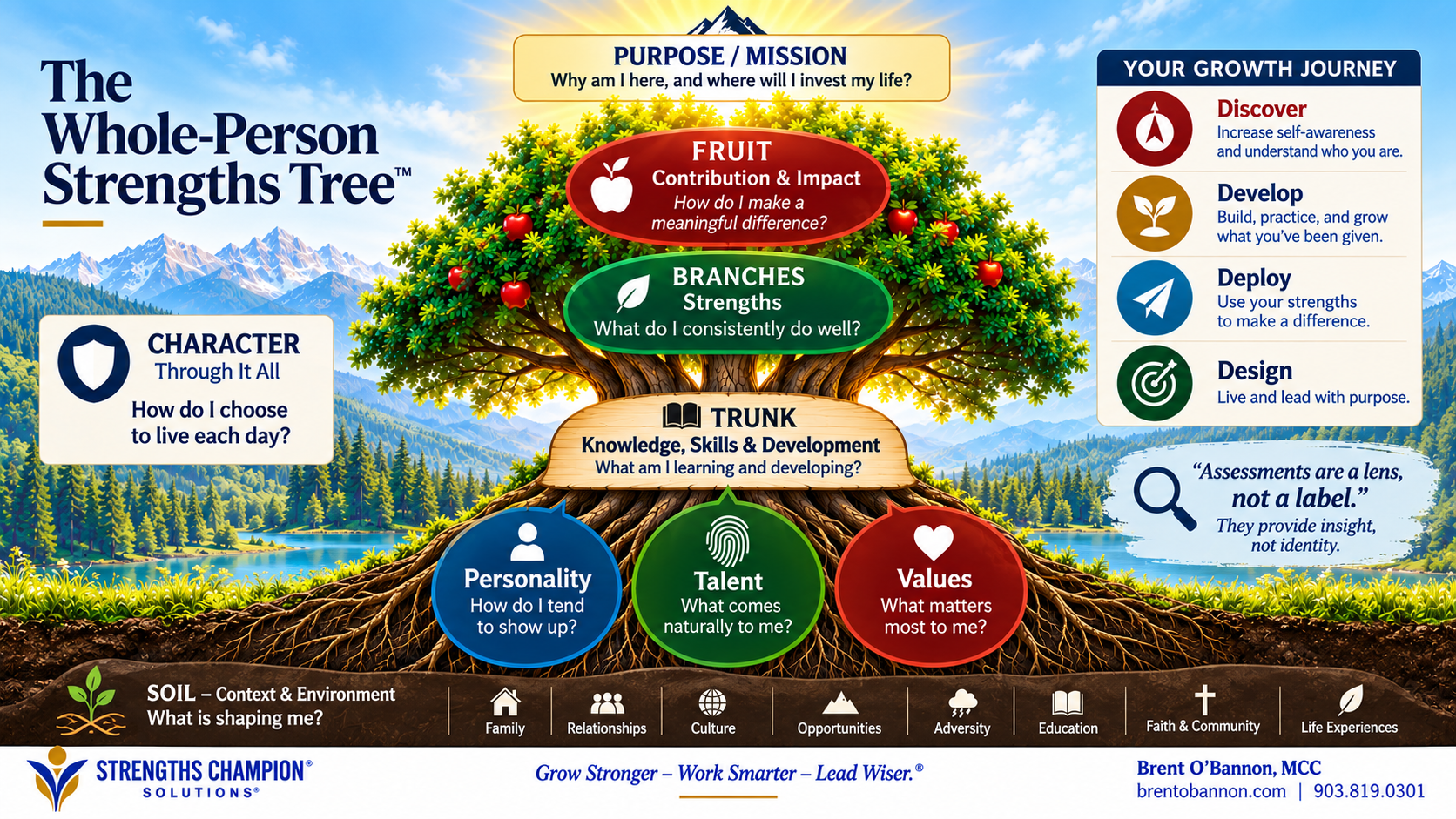
A tree does not produce fruit for itself. Fruit is what others can experience because the tree is healthy and growing. In the Whole-Person Strengths Tree™, the fruit represents Contribution and Impact: How do I make a meaningful difference?
This is where strengths connect to purpose.
Maybe your Strategic thinking helps an organization see a path forward.
Maybe your Developer helps emerging leaders recognize their potential.
Maybe your Responsibility creates trust because people know you will follow through.
Maybe your Communication helps a complex idea become understandable.
Maybe your Relator helps create a team where people genuinely know and trust one another.
The strength is valuable, but the impact is what matters.
The Fruit Exercise
Complete these sentences:
Because of my strengths, people can…
My team is better able to…
My organization is able to…
My family or community is stronger because…
One contribution I want to make more intentionally is…
Now ask yourself: Who is better because I am using what I am good at?
That question can change the way you think about strengths.
Purpose Is the Direction of the Tree
At the top of the Whole-Person Strengths Tree™ is Purpose and Mission: Why am I here, and where will I invest my life?
This question changes the conversation. You can be highly talented and still be unclear about what you are building your life around. You can be productive without being purposeful. You can achieve your goals and still wonder whether they were the right goals.
That is why strengths development cannot stop at performance. The deeper question is: What are you going to do with your strengths?
For a leader, purpose provides direction for contribution. It helps answer where your energy, time, attention, and talents should be invested.
Purpose Reflection
Ask yourself:
-What do I care deeply about?
-What problems do I want to help solve?
-Who do I want to serve?
-What kind of legacy do I want to leave?
-Where does my energy feel most meaningful?
-What would I regret not contributing?
-How do my strengths help me pursue that purpose?
Your purpose does not have to fit neatly into a job title. Your career may change. Your role may change. Your responsibilities may change. But understanding what matters to you can help you make more intentional decisions about where you invest your life.
Character Through It All
There is another element in the Whole-Person Strengths Tree™ that deserves special attention: Character. How do I choose to live each day?
This matters because talent alone does not determine what we do with our abilities.
A person can be incredibly persuasive and use that ability to manipulate.
A person can be highly strategic and use that ability purely for personal gain.
A person can be exceptionally productive while neglecting the people around them.
A person can have enormous influence and still make poor choices about what that influence is used for.
Your strengths describe what you naturally bring. Character speaks to how you choose to use it. This is where the biblical perspective becomes particularly powerful.
God Is Interested in the Whole Person
Jesus said: “Love the Lord your God with all your heart and with all your soul and with all your mind and with all your strength.” Mark 12:30
Heart. Soul. Mind. Strength. That is a picture of the whole person.
And there is another biblical passage that gives us a helpful standard for how we use what we have been given. 1 Corinthians 13 describes love as patient and kind. It warns against envy, pride, arrogance, selfishness, and resentment. It calls us toward truth, protection, trust, hope, and perseverance.
Imagine putting your strengths through that lens.
-What happens when your Communication is guided by kindness?
-What happens when your Command is guided by humility?
-What happens when your Competition can celebrate someone else’s success?
-What happens when your Strategic thinking serves people rather than simply advancing your own agenda?
-What happens when your Achiever learns to slow down enough to be present with the people who matter most?
Your strengths are powerful. Character helps determine the direction of that power.
Peter: When Strengths and Character Are Still Developing
Peter offers another compelling picture. He was bold, outspoken, and willing to act. He was also impulsive and sometimes struggled to understand what Jesus was doing.
Peter’s story reminds us that a person’s natural tendencies do not tell the whole story of who they can become. Development takes time. Peter did not become a different person by becoming someone else. He was transformed through relationship with Christ, experience, correction, restoration, and purpose.
That is a very different approach to leadership development than simply handing someone a personality assessment and saying: “This is who you are.”
From Discover to Design
The Whole-Person Strengths Tree™ includes a four-part growth journey:
Discover
Increase self-awareness and understand who you are.
Understand your talents, personality, values, experiences, and the context that has shaped you.
Develop
Build, practice, and grow what you’ve been given.
Add knowledge. Build skills. Practice. Receive feedback. Develop character.
Deploy
Use your strengths to make a difference.
Take what you have developed and put it to work in your relationships, leadership, organization, family, community, and calling.
Design
Live and lead with purpose.
Make intentional decisions about where you invest your time, energy, attention, and strengths.
This progression matters. Too many people stop at Discover. They take the assessment, they read the report, they put their results in their LinkedIn profile, and then they move on.
Discovery is only the beginning. The real opportunity is to move from: “This is who I am.” to “This is what I’ve been given.” to “This is what I’m developing.” to “This is how I’m going to use it.” to “This is the difference I want my life to make.”
That is the journey from self-awareness to purpose.
You Are More Than Your Top Five
I love CliftonStrengths because it gives people language for something they may have struggled to explain their entire lives. It helps people recognize what is right with them. It helps teams understand differences. It helps leaders identify natural patterns and learn how to intentionally aim their talents.
But the goal was never to reduce a person to five words on a report. Your Top 5 are branches. They are important. They are worth developing. But they grow from deeper roots.
Your personality.
Your values.
Your experiences.
Your knowledge.
Your skills.
Your character.
Your faith.
Your purpose.
And the environment in which you have been planted.
The question isn’t simply: “What are my strengths?”
The question should be: “Who am I becoming, and how will I use everything I’ve been given to make a meaningful difference?”
That is what it means to coach the whole person. And that is where strengths move from self-awareness to transformation.
Your Next Step
View the corresponding Whole-Person Strengths Reflection Guide to walk through the four stages of growth.