
What if your CliftonStrengths Top 5 are only the beginning of the conversation?
For many people, discovering their CliftonStrengths is a powerful moment of self-awareness. Suddenly, patterns that have shaped the way they think, work, lead, and relate to others have names.
You may discover that you are naturally Strategic. You see possibilities others miss.
You may be an Achiever who wakes up with an internal drive to accomplish.
You may be a Relator who builds deep relationships and does your best work with people you trust.
You may be a Learner who comes alive when you are growing.
These discoveries matter, but there is a danger when we reduce a whole person to five themes.
You are more than your Top 5. Your strengths are part of your story, but they are not the whole story.
That is why I created the Whole-Person Strengths Tree™.
CliftonStrengths Gives Us a Powerful Starting Point
CliftonStrengths helps us understand our natural patterns of thinking, feeling, and behaving. Gallup identifies 34 CliftonStrengths themes, organized into four domains: Executing, Influencing, Relationship Building, and Strategic Thinking.
That framework gives us valuable language for understanding what we naturally bring. But knowing your talents is different from understanding the whole person who possesses those talents.
Two people can have the same Top 5 and use them very differently. Why? Because strengths operate within a larger human story.
Your personality influences how you tend to show up.
Your values influence what matters most to you.
Your knowledge and skills influence what you have learned to do.
Your character influences how you choose to live.
Your environment shapes you.
Your experiences shape you.
Your purpose gives direction to your life.
And ultimately, the question becomes: How will you use what you have been given to make a meaningful difference?
That is where coaching the whole person becomes so important.
The Whole-Person Strengths Tree™
Think about a tree. A healthy tree is more than its fruit. It has roots. It has a trunk. It has branches. It grows in soil. And eventually, it produces fruit. People are much the same.
The Whole-Person Strengths Tree™ is designed to help us look beyond a person’s Top 5 and understand the different elements that contribute to who they are and how they lead.
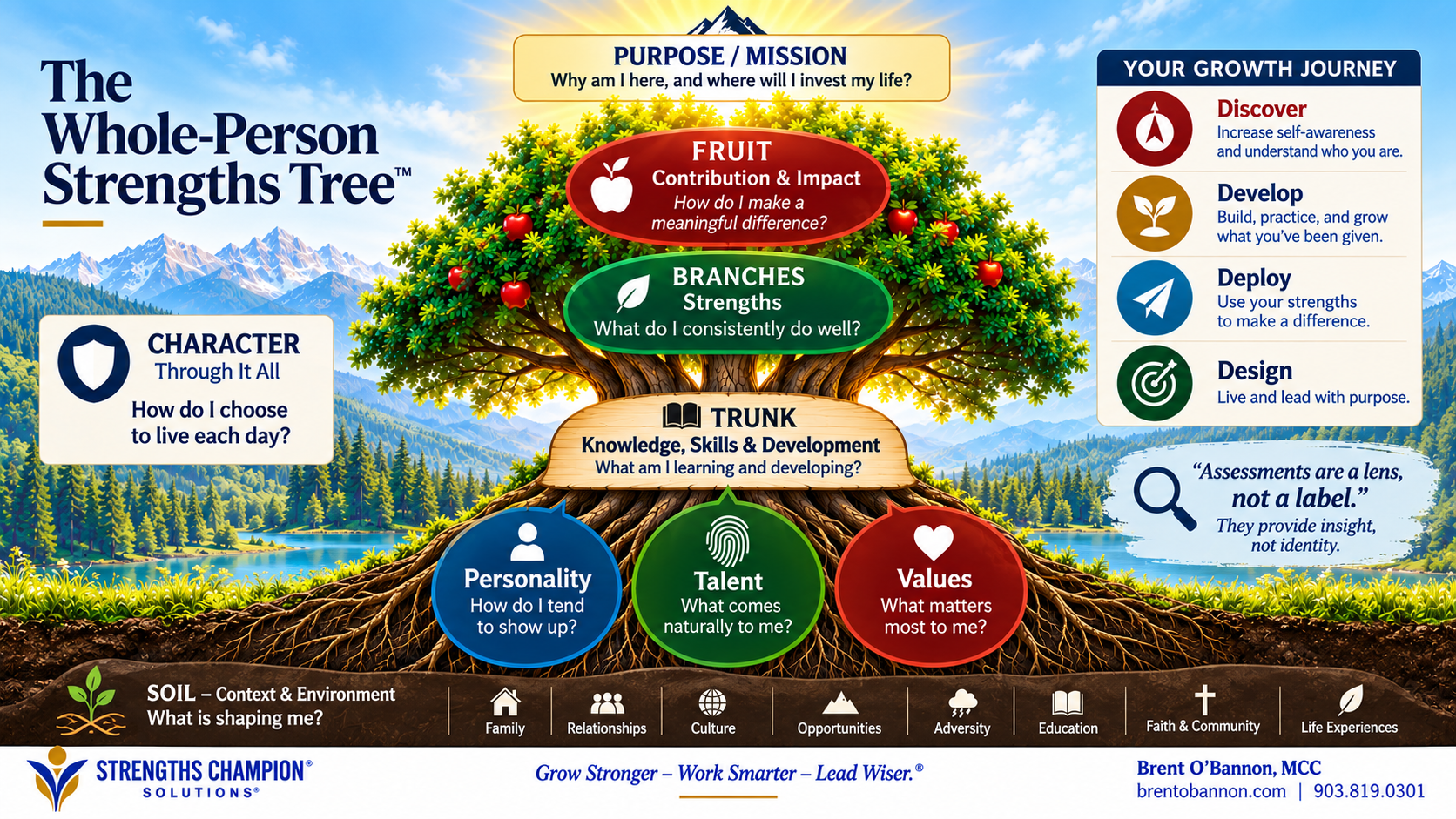
The model asks us to look at the whole tree.
Soil: What is shaping me?
Roots: What comes naturally to me? What matters most to me? How do I tend to show up?
Trunk: What am I learning and developing?
Branches: What do I consistently do well?
Fruit: How do I make a meaningful difference?
And running through all of it is character, purpose, and the choices we make about how we live.
Let’s look at the first three parts of the tree.
The Soil: Context and Environment
Every tree grows somewhere. The soil matters.
For people, the soil represents the context and environment that have shaped us: family, relationships, culture, opportunities, adversity, education, faith, community, life experiences. These things do not completely define us, but they influence us.
Consider two leaders with the same talent for taking charge. One may have grown up in an environment where speaking up, debating ideas, and taking initiative were encouraged. Another may have learned early that challenging authority came with consequences. They may have similar natural tendencies, but their experience with those tendencies could be very different.
The same is true of someone who has experienced significant adversity. That experience may influence how they approach risk, resilience, opportunity, or failure.
Someone shaped by a strong faith community may approach purpose, responsibility, and service differently from someone whose worldview developed in a very different environment.
This is why good coaching requires curiosity.
Before asking: “What are your strengths?”
Sometimes we need to ask: “What has shaped you?”
A Whole-Person Reflection: Look at Your Soil
Take a few minutes and think about the soil in which your life has grown.
Ask yourself:
-What experiences have shaped the way I lead?
-What did my family teach me about work, success, relationships, or responsibility?
-How has my culture influenced the way I communicate or make decisions?
-What adversity has changed me?
-Who has invested in me?
-What opportunities changed the direction of my life?
-What role have faith and community played in shaping me?
-What environments bring out the best in me?
You may discover that some of the things you assumed were simply “who you are” have also been shaped by where you have been planted. That is worth knowing.
The Roots: Personality, Talent, and Values
The roots of the Whole-Person Strengths Tree™ represent three foundational elements:
Personality: How do I tend to show up?
Talent: What comes naturally to me?
Values: What matters most to me?
These three things can interact, but they are not interchangeable.
CliftonStrengths gives us an important window into talent. Gallup describes the 34 themes as natural patterns that can be developed and applied. But talent is not the same thing as personality. And talent is not the same thing as values.
A person may naturally be competitive, but that does not tell us what they value.
Someone may naturally influence others, but that does not tell us what they will choose to influence people toward.
Someone may naturally analyze problems. That does not tell us what they believe is worth solving.
Talent gives you capacity. Values give that capacity direction. That distinction matters for leaders.
Try This: The Three Questions
Choose one of your Top 5 CliftonStrengths. Then answer three questions:
TALENT: What does this talent help me do naturally?
VALUES: What do I care about that I want to express through this talent?
PERSONALITY: How does the way I tend to show up affect how this talent gets expressed?
For example, someone high in Competition may naturally compare performance and want to win. However, Competition does not tell us what that person values. One leader might channel that drive toward raising the standard for the entire team. Another might need to become more intentional about how competition affects relationships.
The talent is similar. The person using the talent is different.
The Trunk: Knowledge, Skills, and Development
A tree needs a strong trunk to support what grows above it. For people, the trunk represents knowledge, skills, and development.
You may have a natural talent for influencing people, but leadership requires more than natural talent. You have to learn, practice, receive feedback, develop skills, make mistakes and learn from them. You have to grow.
Gallup’s strengths framework makes an important distinction here. Talent is a natural way of thinking, feeling, or behaving. Investment through knowledge, skill development, and practice helps turn that talent into a strength.
This is one reason I encourage people not to stop with their CliftonStrengths results. Your Top 5 can tell you something about what comes naturally. They do not tell you everything you need to know about how to lead.
The focus becomes: What are you doing with what you naturally have?
Try This: Talent + Investment
Choose one of your Top 5. Now look beyond the assessment.
Ask:
-What knowledge have I gained that makes this talent more useful?
-What skills have I developed?
-Where have I practiced this talent?
-What feedback have I received?
-What mistakes have taught me something?
-Where have I become more effective over time?
-What still needs development?
For example, someone with strong Communication may naturally find it easy to put thoughts into words, but becoming an effective communicator requires much more than having a natural ability to talk.
It may require learning how to listen. Learning how to tell a compelling story. Learning how to communicate with different audiences. Learning when to speak and when to pause. Learning how to communicate difficult information with clarity and care.
The talent provides an opportunity. Development determines what you do with it.
Look at the Whole Tree
At this point, you can begin to see why a Top 5 report cannot tell the whole story. Your Top 5 are important, but underneath those themes are roots. And those roots have grown in soil.
Your personality.
Your talent.
Your values.
Your experiences.
Your relationships.
Your culture.
Your education.
Your faith.
Your adversity.
Your opportunities.
Your knowledge.
Your skills.
All of these contribute to the person who eventually expresses those strengths.
A Whole-Person Coaching Exercise
Take a piece of paper and draw a simple tree. You can use the Whole-Person Strengths Tree™ as your guide.
Start at the bottom.
SOIL: What has shaped me?
Write down the experiences, people, environments, opportunities, adversity, and communities that have influenced you.
Move to the roots.
PERSONALITY: How do I tend to show up?
TALENT: What comes naturally to me?
VALUES: What matters most to me?
Move to the trunk.
KNOWLEDGE: What have I learned?
SKILLS: What have I developed?
Now step back and look at the whole picture. What do you notice? What parts of your story have influenced the way you use your strengths today? What assumptions have you made about yourself that might deserve another look?
Assessments Are a Lens, Not a Label
This is one of the central ideas in the Whole-Person Strengths Tree™: Assessments are a lens, not a label.
An assessment can provide insight. It cannot provide identity.
Your CliftonStrengths results can help you understand patterns. They cannot:
-Tell you everything you value.
-Measure the full impact of your life experiences.
-Determine your character.
-Tell you your purpose.
-Define everything you are capable of becoming.
This is especially important for younger leaders who are still building careers, relationships, identities, and visions for the future. Your current results are a snapshot of something. They are not a ceiling.
God Is Interested in the Whole Person
The biblical perspective adds another dimension to this conversation.
Jesus was asked which commandment was the greatest. His response was not simply about what we do. He pointed to the whole person:
“Love the Lord your God with all your heart and with all your soul and with all your mind and with all your strength.” Mark 12:30
Heart. Soul. Mind. Strength.
There is something remarkably holistic about that command. God is not asking for one compartment of our lives. He is calling us to bring our whole selves.
That has implications for how we think about strengths.
Your CliftonStrengths are part of who you are, but they do not define the entirety of who you are.
You are more than your talents.
You are more than your personality.
You are more than your accomplishments.
You are more than your job title.
You are more than your Top 5.
The Question Beneath the Assessment
A strengths assessment can help you answer: What comes naturally to me?
But coaching the whole person asks additional questions:
-What has shaped me?
-What do I value?
-What am I learning?
-What am I developing?
-Who am I becoming?
Those questions move us from assessment toward development. From information toward self-awareness. From a profile toward a person. And from knowing your strengths toward understanding how those strengths fit into the larger story of your life.
That is where the Whole-Person Strengths Tree™ begins.
In Part Two, we’ll move above the surface and explore the branches, fruit, purpose, character, and contribution of the tree.
Discovering who you are is only the beginning. The bigger question is: What are you going to do with everything you’ve been given?



I really loved this blog and the tree analogy – it will definitely add to my coaching practice – thank you Brent!
Thanks for reading and sharing Bev! What ideas do you have utilizing the Whole Person Strengths Tree model?